On 4 June 2020, the GMC (General Medical Council) wrote to inform me that it had erased my name from the UK register of medical practitioners and revoked my licence to practise. In other words, I had been struck off. I hadn’t done anything wrong. I had taken early retirement to escape the relentless pressure and stress of life on the NHS frontline as a consultant in anaesthesia and critical care medicine. After forty years, I was burnt out. The letter from the GMC marked the formal conclusion of my medical career. I was no longer entitled to call myself a doctor. If I did try to pass myself off as one now, I would be breaking the law.
I had a vocation to become a doctor and to minister to the ill, diseased, injured and dying from as far back as I can remember. At least, that’s what I think you expect me to say. In truth, however, I never really had that vocation thing. I hadn’t the foggiest idea what I wanted to do with the rest of my life while I was at school. Lawyer? Teacher? Particle physicist? Airline pilot? Doctor? Who knew? I certainly didn’t. I had to choose something to study at university, though, so I plumped for medicine. My decision pleased Dad, and my best friend had applied to go to medical school. Plus, doctoring was a steady job with kudos and paid well.
I was an anaesthetist for nearly all my career. Most people have only the vaguest notion of what an anaesthetist does, their knowledge acquired from watching medical dramas on TV. An intravenous injection of a sedative draught or a whiff of gas sends the patient off to sleep. At the end of surgery, an antidote is administered, or the gas is simply turned off, and the patient wakes up. In between times, there’s nothing much to do except complete The Daily Telegraph cryptic crossword. Simples. Surveys show that half of the general population does not know that anaesthetists are medically qualified doctors. A patient once asked me what it was like to be an anaesthetist. I was delighted that she was so interested, and I enthusiastically gave her chapter and verse about what a fascinating and professionally challenging job it was. My bubble burst when she remarked, ‘I think my son would like that. He didn’t get high enough grades to get into university. Being an anaesthetist would suit him down to the ground. Can you study it at night school?’
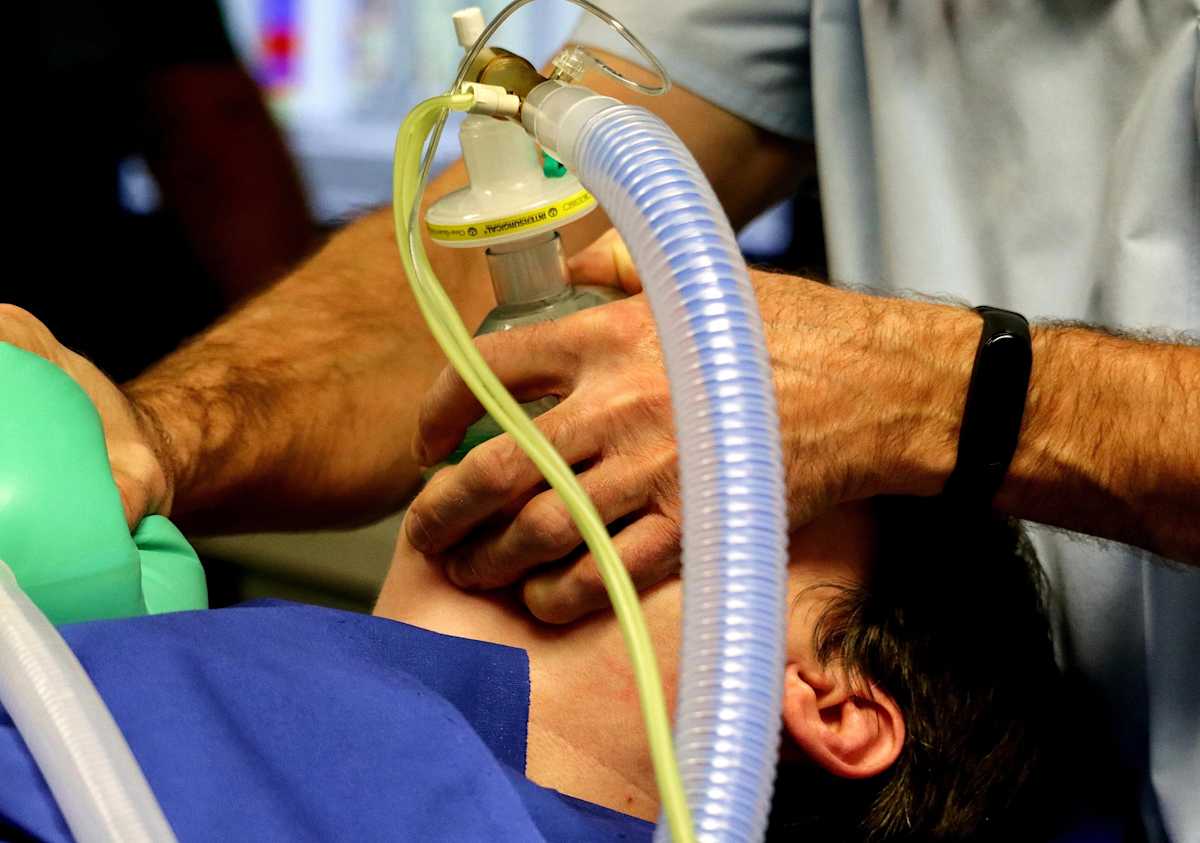
The main reason people take that view of anaesthetists stems from their ignorance of what general anaesthesia entails. As anaesthetists, we don’t help the cause by casually referring to the induction of general anaesthesia as “going to sleep”. Such language only serves to reinforce the picture of a patient dropping off into a deep, contented, peaceful snooze, little different and no more risky than taking an afternoon nap on the sofa after a huge Sunday roast. In reality, general anaesthesia has almost nothing in common with regular sleep. It is a state of deep, unresponsive coma. An anaesthetised person is as close to death as it is possible to get without actually being dead. A deeply anaesthetised subject undergoing brainstem function testing would be diagnosed as brainstem dead.
A consultant anaesthetist studies to become a doctor at medical school for five or six years and then trains in hospitals as a junior doctor for another ten years or so. I would argue that this length of time is hardly necessary to learn how to induce this state of deep, unresponsive coma, which any Tom, Dick or Harriet could do with minimal training. But it is essential to ensure you safely wake up again from your deep, unresponsive coma, and without your brain having been scrambled or you suffering any other serious adverse sequelae.
Giving anaesthetics in the operating theatre was only half of my job as a consultant. The other half was spent caring for critically ill patients in the ICU (Intensive Care Unit). Critical care is another part of an anaesthetist’s job description that is not well appreciated. Most people are unaware that anaesthetists have any role in the running of ICUs, let alone that most intensivists are anaesthetists. Anaesthetists also work on the labour ward, inserting epidurals, and in chronic pain clinics. They lead cardiac arrest teams and teach other doctors, nurses and paramedics the principles of resuscitation. In fact, there is almost nowhere in the hospital where you won’t find an anaesthetist, and 70% of all hospital inpatients encounter an anaesthetist at some point during their admission.
I thoroughly enjoyed the challenges, the job satisfaction and the privilege of being a doctor, but the positives came at a price. My wife will tell you I often wasn’t there for her or our two daughters. When my girls were growing up, I missed out on meal times, bath times and bedtime stories; playing in the park, birthday parties and days out; school concerts, parents’ evenings and sports days. My work-life balance was often unbalanced, and the years of toil took their toll. When I reached my early fifties, I realised I was suffering from burnout. Something had to change, and I made plans to take early retirement.
The last patient I anaesthetised woke up on Tuesday, 31 March 2020, at 12:45 pm. My logbook records his details: 61-year-old male; ASA III; elective ureteroscopy and laser to stone; surgeon Miss Greene; general anaesthesia; tracheal intubation; uneventful.
After his operation, I handed over his care to the recovery nurse, went to the changing room to get dressed and walked out of the hospital for the final time as a doctor. There was no fanfare, impromptu party, handshaking, retirement present or speeches. I left unnoticed as if it were any other day. But these were extraordinary times. The COVID-19 pandemic was gearing up. An awful sense of impending doom pervaded the hospital, and normal service was suspended.
Even though I was retiring, I expected to return to work after a fortnight’s break. With the anticipated tsunami of critically ill coronavirus victims rapidly approaching, my medical director had asked me if I might ‘possibly come back to help out for a bit,’ and I’d agreed. As it turned out, my further services were not required.
When I reflect on my adventures at medical school, on the wards, in the operating theatre and in the intensive care unit, and recall the patients I have been privileged to meet and care for, I can scarcely believe it all happened. There were times of great joy and times of even greater sadness. I achieved much that I am proud of. However, there were many occasions when I experienced intense frustration. Triumphs were counterbalanced by tragedies; hilarity by horror; mundanity by absurdity. Mentally replaying all these events is like watching the scenes of a movie. Those scenes are the chapters in these three books.
To answer the question posed at the beginning of this post, I decided to write my story, first and foremost, to prove to myself it really did happen. In the process of transferring my memories into my memoirs, I relived so many experiences and remembered so much I thought I had forgotten. Reading my books has helped me appreciate how lucky I was to enjoy a long and successful career as a doctor. If you read them too, I hope you'll be moved. At times, they will make you laugh, at others they will make you cry. You won't believe some of what goes on, but trust me it does! Reading my life story won't only be an entertainment, it will be an education.