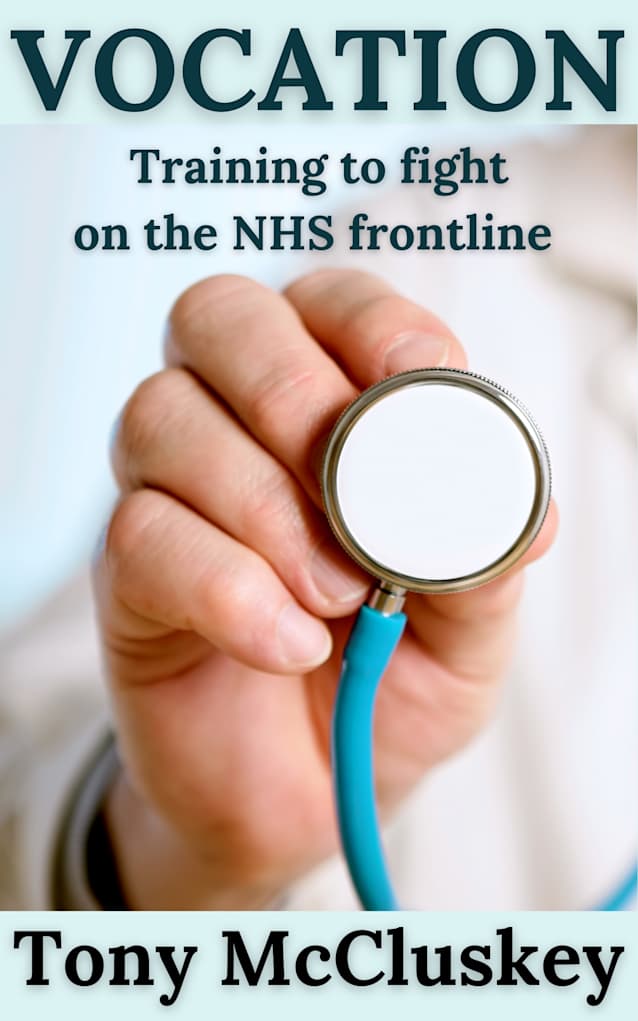
VOCATION
About
Tony plans to save the world one patient at a time, but first, he has to survive the training.
Tony McCluskey is brimming with youthful vigour and enthusiasm at the start of a six-year training programme to fight death and disease on the NHS frontline. Even though his first patient is already dead, there's a lot Tony can learn from somebody with formaldehyde rather than blood in their veins. But the lessons learnt at medical school do little to prepare him for the organised chaos of an NHS hospital ward. Welcome to a world of 100-hour weeks, life-and-death decisions, and a tsunami of bodily fluids. Tony quickly realises it’s sink or swim.
The hard reality of keeping his patients out of the grim reaper’s clutches is more challenging than Tony ever imagined. The relentless pressure of the long hours, sleepless nights and constant stress of dealing with death and dying begins to exact its toll. The dream turns into a nightmare, and nothing can prepare Tony for the shattering blow of being accused of causing the death of one of his patients. Medicine was a vocation, but nobody had told Tony it was also a war of attrition.
Vocation is the opening chapter of the raw, no-holds-barred tale of Tony's forty-year medical career. His adventures at medical school, on the wards and in the operating theatre transport readers on an emotional rollercoaster as the sorrow and joy, tragedy and triumph, mundanity and absurdity, and the horror and hilarity of life as a junior hospital doctor are laid bare. It’s an eye-opening, hilarious, yet often heartbreaking, insight into life on the NHS frontline.
If that introduction has whetted your appetite, why not delve right in?
Here are the first two chapters...
Praise for this book
Humour and heartbreak.
Step aside Adam Kay, there is a new Doc in town. This book delivers a vivid, honest portrayal of medical training, balancing humour and heartbreak with impressive ease. The author captures the absurdity of hospital life—the sleepless nights, the dark humour, the small, surreal moments that keep doctors going—while never losing sight of the emotional weight that comes with the job. It’s laugh-out-loud funny in places, but the laughter often catches in your throat as the reality of the situation sinks in. Looking forward to the 2nd instalment.
An honest sincere recollection of a lifetime's career.
Like Tony, I qualified as a Medical Practitioner in the late 1970s, and can empathise completely with his description of Medical School Life. I had expected a 'MASH' meets 'All Creatures Great and small'... but it far exceeds that. It reminds me of the brutally honest confessional music of the 70's West Coast. So if Joni Mitchell's 'Both Sides Now' moves you.. then 'Vocation' is a bucket list novel for you.
Heartbreakingly honest; a one-sitting read.
A fabulous read. An honest and eye-opening account of the realities of life as a junior doctor. I read it in one sitting and am looking forward to the next instalment.
An unredacted account of medical training.
His first of a three-volume medical memoir opens with an arresting choice: a grim, detailed case history that sets the tone for what follows. Tony proves himself an assured storyteller in these clinical vignettes. The detail is often unflinchingly visceral, and the outcomes—frequently fatal—are usually delivered without sentimentality.
The narrative shifts perspective in chapter three, when we are taken back to Tony’s schooldays. and the prankster schoolboy who only applies for medicine to please his father and because his best friend has. From there, the memoir moves at pace through his early years at medical school, formative encounters with eccentric and often larger-than-life teachers.
An elective in India provides some of the book’s most vivid passages, offering both author and reader a genuine shift in perspective. Here, Tony’s observational energy feels freshest. Elsewhere, however, the sense of place is curiously underdeveloped. Despite its Manchester setting, the narrative largely sidesteps eighties Manchester. The Madchester music scene is absent, and the Curry Mile and football culture are barely acknowledged. The result is a setting that feels interchangeable with almost any NHS hospital environment.
The memoir’s real subject is not place but the rhythms and pressures of hospital life. Tony captures these with economy and authenticity—emergency department chaos, endless outpatient clinics, interminable ward rounds, and chronic sleep deprivation. The recurring motifs are familiar but effectively rendered: the tyranny of the bleep, the authority of the ward sister, the jittery exhaustion of life on call, the fleeting refuge and camaraderie of the doctors’ mess, the sustenance provided by caffeine and convenience food. Case histories are dotted throughout, providing narrative anchors, and mostly recounted with a droll, gallows humour. At times, however, the brisk pace comes at the expense of deeper reflection.
The book’s most compelling section arrives in its extended account of a clinical catastrophe and its aftermath. Here, the narrative slows appropriately, tracing a case from first presentation through to collapse and death, the ensuing complaint, and legal scrutiny. Tony’s first encounter with the adversarial nature of the British legal system is rendered with clarity and restraint, and the emotional stakes feel more fully realised than elsewhere.
By the close of this first volume, Tony is changed—more experienced and not too disillusioned. He stands on the threshold of marriage and a career in anaesthetics and intensive care, his sense of purpose intact. Our hero has completed a satisfying narrative arc: from accidental entrant to committed practitioner.
Positioned alongside other recent doctor-authored memoirs—across palliative care, war surgery, neurosurgery, and obstetrics—Vocation holds its place comfortably. Its strengths lie in narrative drive and clinical detail. If it occasionally sacrifices depth for pace, it remains an engaging and candid account, and a worthwhile contribution to the genre.
Frank, funny… and full of heart
This book offers a fascinating and heartfelt look into a life dedicated to medicine. Through equal parts humour, sincerity, and compassion, the author provides a frank account as a newly qualified dr, embarking on the beginning of 40+ year long career. The writing is honest, engaging, and full of insight, making it an enjoyable read whether you’re in the medical field or simply curious about it. It’s both inspiring and deeply human - a wonderful reflection on a meaningful career. I devoured this in one sitting and eagerly await delivery of the second instalment!
Laugh out loud and be moved by the real life experiences of a great medical author.
This wonderful book takes one through the highs and lows of being a doctor and gives a snap shot of how it was to train in the 1980s . The humanity, humour and pathos reflect what it feels like to practice medicine in any era and any place .
This sits comfortably alongside Cronin and Kay and will be enjoyed by doctors and patients alike .
Looking forward to reading the other books in the trilogy.
Entertaining account of medical training.
With a easy writing style Tony McCluskey shares an honest, open, amusing, and at times moving account of medical education in the 1980s, including the good and the bad, and the excessive hours and workload inflicted on junior doctors in that era.
Heartbreakingly honest; a one-sitting read.
A fabulous read. An honest and eye-opening account of the realities of life as a junior doctor. Read it in one sitting and looking forward to the next instalment.